Earlier this summer, AHL hosted a panel on climate resiliency as part of its Art+Design+Architecture series. We revisited the conversation with Dr. Charles “Chip” Fletcher, Dean of the School of Ocean and Earth Science Technology at the University of Hawaiʻi at Mānoa, in the wake of the storms we have been seeing this month.
HCJ: Could you help us understand the weather patterns we are seeing right now and whether storms are becoming more frequent and devastating?
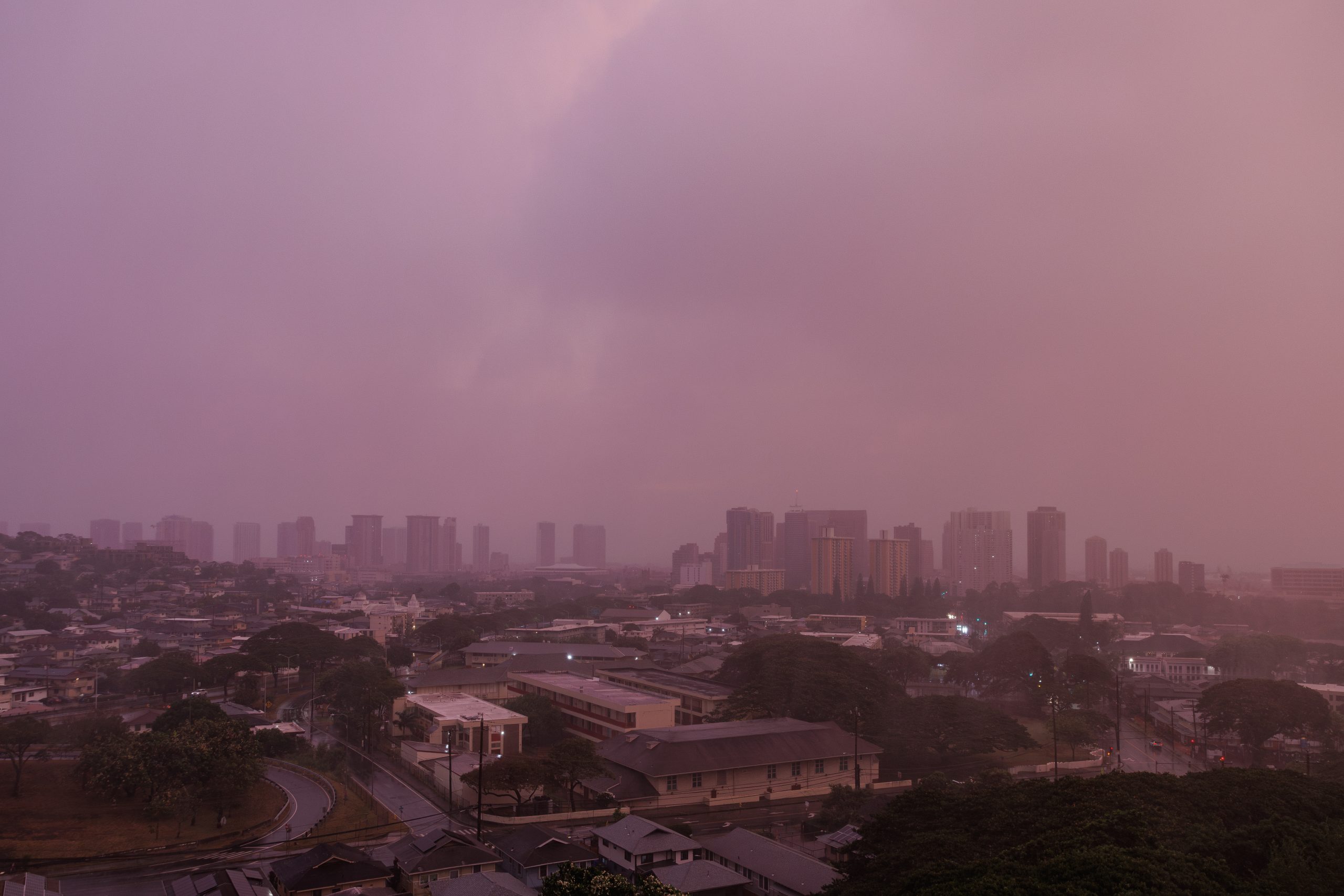
Dean Fletcher: Climate change is supercharging tropical cyclones in the Pacific Ocean, making them far more dangerous than a generation ago. Warmer ocean waters act as fuel, forcing hurricanes to grow physically larger, dump heavier rain, and intensify at historic speeds. Because these storms now move more slowly, they can stall over one area and trigger catastrophic flooding. This reality is hitting Hawaiʻi right now, where human-caused warming and natural cycles are combining to power extreme hurricane seasons, as seen with Hurricane Lala and Tropical Storm Moke.
HCJ: What should we understand about the uniqueness of El Niño this year?
Dean Fletcher: A powerful “Super El Niño” is developing in the Pacific, with a 90% chance of becoming one of the strongest on record since 1950. For Hawaiʻi, this fuels an unusually active tropical cyclone season through the fall, followed by a much drier winter and spring. This dry period brings weaker trade winds, high risks of drought and wildfire, and warmer ocean temperatures that can trigger widespread coral bleaching. A warmer ocean provides much more heat to fuel El Niño when they do occur. Recent research warns that these extreme events can push the climate into abrupt, lasting shifts in temperature, ocean health, and soil moisture that persist long after the Pacific cools down.
HCJ: In the past, you have shared about how we will be seeing sea-level rise for the next 1,800 years. Could you tell us how your Climate Resilience Collaborative is a “frontline ‘solutions engine’”?
Dean Fletcher: The Climate Resilience Collaborative (CRC) functions as a frontline “solutions engine” by taking scientific findings and turning them into tools, policies, and plans that communities and governments can use. Our team of experts come from across the UH Mānoa campus, including physical and social sciences, community design, economics, and policy. We go beyond publishing sea-level-rise projections and provide mapping tools for county agencies to write building codes, local planning departments, and at community meetings in the places facing the most acute risk.
One of CRC’s models informed Kauaʻi County’s landmark 2022 ordinance, making it one of the first counties in the nation to base construction and planning on future sea-level-rise projections as well as informing Hawaiʻi’s real estate disclosure law requiring sellers to flag coastal-erosion and sea-level-rise risk.
The CRC is currently leading the Waiʻanae Readiness Review, a year-long, community-co-created climate vulnerability assessment developed with the City and County of Honolulu’s Resilience Office and UH’s wildfire research team, alongside the Koʻolau Poko Resilience Review with Marine Corps Base Hawaiʻi. This work is grown through pilina, with communities, government partners, agencies, and researchers working together in trust and shared kuleana. That combination of science paired with on-the-ground partnership makes CRC a solutions engine rather than a simple research lab.

Courtesy of AHL
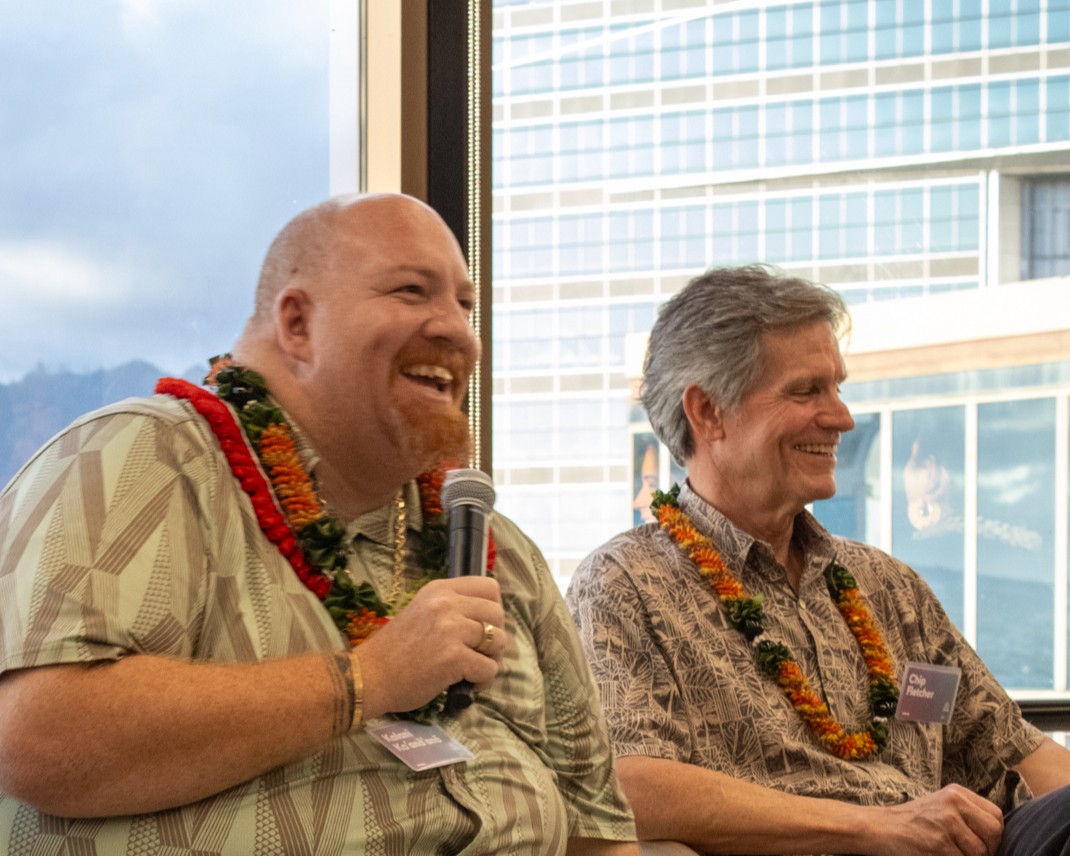
During the panel discussion on climate resiliency, Dean Fletcher shared about the inevitability of sea-level rise for the next 1,800 years. Below is their full conversation on working together, indigenous knowledge, and hope. You can also watch the full video on YouTube.
The panel included:
Dr. Charles “Chip” Fletcher, Dean of the School of Ocean and Earth Science Technology at the University of Hawaiʻi at Mānoa
Dr. Kealoha Fox, Kahu Ola Loa, Chief Resilience Officer of the island of Oʻahu and Executive Director of the Office of Climate Change, Sustainability and Resiliency for the City and County of Honolulu
Christina Jayne, Coral Aquatic Biologist for the Hawaiʻi Department of Land and Natural Resources, Division of Aquatic Resources, and curator of the Hawaiʻi Coral Restoration Nursery
Kalani Kaʻanāʻanā, Chief Executive Officer of Hawaiʻi Green Growth
Bettina Menhert, President and CEO of AHL as moderator
Bettina: As Hawaiʻi works to build a more resilient and sustainable future, it is important to maintain a clear understanding of where we are today and what that clear vision for the future needs to be. We are continuously reminded of how vulnerable we and our islands are—from climate change and coastal erosion to flooding and coral reef decline, from food systems to energy and housing attainability. Resilience must be approached holistically. It cannot sit in one office, one field or one sector. It requires collaboration between governments, sectors such as science and design, community leaders, nonprofits, cultural practitioners, and all of us as residents.
Where do you see the strongest intersection between your work and the work of one another?
Kalani: At Hawaiʻi Green Growth, our work pulls together all the threads to weave them into a tapestry. The intersection of our work is pulling us all into the same place. We started with six government signatories—the governor, the legislature, the four county mayors, and the Office of Hawaiian Affairs—in addition to businesses, nonprofits, and residents. Bringing all that expertise, knowledge, leverage, and love is what I do.
Chip: That was a great answer, and points in the same direction that I will comment:
We cannot afford to “stovepipe” the challenges to our community.
Climate change is only one, and you all know climate change consists of a whole list of hazards of various types. But we also have social inequality. Hawaiʻi is a highly stratified community. We have the richest of the rich and we have the houseless out there on the streets, and 52% of the families in Hawaiʻi have been surveyed and said that they are financially challenged. Half the population here is financially challenged. So how are we going to be a resilient community unless we lift these strata, these layers of society, up?
So it’s critical that we understand social equity as part of our solution to climate change.
It’s also critical that we understand problems related to disease and pollution and biodiversity loss, and the destruction of natural wild places. All of these intersect with climate change, and climate change intersects and amplifies and magnifies all of these. You talk about threads in a cloth—absolutely. Resilience has to address all of these issues and we can’t afford to stovepipe any one of them.
Kealoha: The City and County of Honolulu is a signatory of the Aloha+ Challenge from the very beginning stages of Hawaiʻi Green Growth, and Dean Fletcher is one of the original founding members of the city’s Climate Commission. So I think, for me, my connection is not only in the work that we do but how we work together and who we work with.
So much of that in Hawaiʻi is about pilina. It’s about our relationships. It’s about collective action more than any one person can do.
At the end of the day, for me, between those bar charts and those line graphs, it’s really about us as the people and our concern within the City and County of Honolulu about who is going to be able to live here in the future and how we are going to live—with what level of quality of life—right now. I think my connection to everybody here, including the DLNR that we share the civic center campus with, is really a moral mandate and an obligation that we cannot continue to do business as usual anymore. We cannot continue to govern as business as usual anymore.
That takes a really different perspective on how you balance the opportunities between nonprofit, academia, and government action at the same time that we’re also dealing and contending with so many different shocks and stressors that are starting to show up here in Oʻahu within the greater pilina of the Hawaiian Islands, and that are already very evident and prevalent across Oceania and Moana. Those aren’t easy questions to answer, but for us, I think the response is that we’re going to do government very differently.
Christina: Really lovely points from all of you, and all this discussion just makes me think of how Hawaiʻi is known as being the most isolated archipelago in the world. In a way we have been isolated from many other stressors for so long. But that’s no longer the case.
We cannot keep moving forward the way that we have been doing things this whole time.

Courtesy of AHL
Coming from the environmental side of things, I think the best example is just: look outside. Look at our oceans. Look at our forests. Those ecosystems do not function as silos. They don’t function on their own. Every part of those systems works together, and if you take out one brick, the whole thing can fall apart. We need to work together. We have to get all those different bricks and actually put them in the same place and build something. That’s the first thing I think of as I look at the examples of nature and what we need to follow. That’s really the guide.
Chip: I see our isolation as both a challenge and an enormous benefit. Global warming has now hit 1.5 °C above the pre‑industrial average. That average global temperature consists of about 0.8 °C warming of the sea surface temperature and 2–3 °C warming on the continents. The continents are already burning up, and being on a continent is extremely challenging these days.
An area four times the size of California every year is switching from its normal environment to deep aridification. We don’t call it “drought” anymore because drought implies a cycle that will end. Now we’re seeing permanent aridification of huge areas of the continents around the planet. The water cycle has fundamentally changed.
In Hawaiʻi, we are surrounded by an ocean that is absorbing heat, and we’re suffering less than many continental areas. So our isolation is a challenge, but it’s also a benefit.
Bettina: Why is it important that resilience is being discussed across various disciplines rather than in separate silos?
Kalani: I think for some people it’s too much to handle at once, and so they maybe start in the silo because it feels like the thing they can sort of chew on in that moment.
In Hawaiʻi, our advantage—our competitive advantage—is that we are so small and that everybody knows everybody, right? In that way, if we decide that we want to do something—and we have, in the Aloha+ Challenge, community‑driven initiatives that became shared goals—now we have the shared goals, so what are we doing to address them?
We also have a dashboard, and the dashboard is meant to keep us accountable and transparent about what we’re doing and what we’re not doing.
You know which of the six goals is all red? Solid waste reduction. Our community said we want a 70% reduction in solid waste. Not even an inch on that metric.
So, right—discuss, fine. Pau talk. Let’s discuss what we’re going to do.
Chip: Hawaiʻi has all the elements we need to solve the problem for ourselves and show the rest of the world how to solve the problems. Earth is, after all, an island in the sea of space, and no one’s coming to rescue us.
Hawaiʻi is underpinned by an indigenous foundation of an ethic related to the land and has lessons to teach the whole world.
If we can unleash the ahupuaʻa‑based system, if we can give farmers access to all that open land that’s out there and subsidize them, because farming is a razor‑thin economy, a razor‑thin way to make a living—we need to turn farming into a business in which families are competing to join.
Uncover the kuleana families that are out there that are still working the land in their ahupuaʻa and have been doing it for generations. Uncover the indigenous knowledge that they have and know so well. Release them from the heavy permitting burden that we subject profit‑based companies to go through, which is very appropriate for those companies, but not appropriate for kuleana families and other organizations that want to work the land so that we can have food sovereignty. We need to become sovereign in so many different ways. We need energy sovereignty. We need food sovereignty. We need to care for our water, and learn the lessons from centuries of knowledge here in the islands.
If we can uncover that and support it, we can show the rest of the world how this planet can host communities of people that can thrive in this very dangerous future rather than suffer.
Kealoha: Can I also maybe share another quote from you, Chip? This one still sits with me. “Hope is found in action. Optimism is found in action.”
Hope implies someone else is going to take care of it. Optimism is what we engender in ourselves when we take some action. You forget about feeling dismal if you’re doing something constructive. So everybody getting involved is the key to building community optimism.
I think that’s where we’re succeeding right now—community action that has created really tremendous results. My agency was created 10 years ago by people like you and me who voted to create this office and create an opportunity for the counties to have a say in what our climate‑resilient futures look like.
In the last charter amendment, it was within my office that you folks, including myself, voted for the first‑ever climate resiliency fund.
We are making these policy shifts together, but we’re also doing it through the power of the people. People power, I believe, is completely fueled by hope and optimism. I don’t actually see a lot of us in Hawaiʻi activated through fear and scarcity. I see us being really motivated by all of those positive affects that you just mentioned and all of those systems that are really inter‑reliant on one another. We have data and information, but we also have stories and memory right here for us to take advantage of. I believe that’s why so many of us have started to push for these shifts and absolutely refuse to accept policies that don’t represent what we truly believe in our own homes, businesses, and schools. We want to make sure that’s being reflected in these acts, regulations, and laws.
Christina: I’m young, but in the past several years we have really seen so much momentum, so much of that optimism, and not just folks talking, but wanting to take action and do. That is so incredibly important.
There are so many students that I see, so many young people who are just ready to jump in.
They want to see those changes, and they’re actively, like, “I want to do this, and I’m motivated, and I want to go find out: how do I get involved in this office? How do I get involved and learn about the rule‑making process?”
Just seeing that there are folks who are also taking what you might think of as baby steps—but I think we are at that point where we’re bringing all those silos, all those baby‑step stages, together and creating that larger movement.
Bettina: It’s wonderful to hear all of you talk about optimism. You talk about community, and Hawaiʻi is often praised for its strong sense of community. But recent events have also shown how vulnerable we are. What do you think this moment is asking us?
Chip: I think this moment is asking us to get out of our box—to really challenge ourselves as individuals in our personal lives, as employees in our offices and divisions and companies, and as members of our families. Challenge ourselves to sit down and think, “All right, I want to do things differently because I recognize and accept that the world is changing and has changed already.” One thing you might realize is that you’re here because you love Hawaiʻi, right? If you love this place, you have to get involved. You have to dig in. And to dig in properly, you need to learn.
Then you need to think: what is it that we can all imagine creatively and in a new and fresh way that moves like a tsunami in the same direction we’ve been talking about? Can you share this with somebody so you’re not doing it alone, and can the group of you bring an entire large group in the same direction?
So let’s get outside of the noise in our head and the boxes we live in, and let’s read. Let’s raise awareness in ourselves of some of the details we’re talking about here, and let’s imagine together what a new tomorrow can look like.
Kalani: I’d add that I think the moment is asking us to wise up. We need to start challenging some of these tropes and this language that we hear about the problems—and really challenge them. You hear, “Oh, kids don’t want to farm.” I just spent two months ago with Future Farmers of America. Those kids are revving to go. They love it. FFA is their jam. How do we actually empower them to do it?
So how do we challenge the tropes, the language, and the words we’re hearing? Because it’s not always true. Let’s put our words into something and feed that energy.
How do we feed the things that actually bring us life and resilience and thriving, and start feeding those narratives—and starve the narratives that don’t serve us?
Christina: I think of preparedness. Not just for storms like the Kona lows and some of the other impacts that we’ve had recently—but, well, one: you can never be too prepared. I also think of preparedness not just for environmental impacts, storms, flooding, or having your hurricane kit in your house, but preparedness for what is to come and what we need to do to reach that point.
Preparedness for, “Okay, we want to start getting down on that solid‑waste reduction—well, what does that mean? What does that mean for the average person? What do they need to do so that we can start working on those numbers?” That’s the first thing that pops into my mind: you can never be too ready for environmental impacts, and you can never be too ready for the change you want to see happen.
Bettina: I’m going to shift a little bit. All of you talk about how special Hawaiʻi is. So how can we pursue modernization and the economic growth that comes with it, and climate adaptation, while we remain grounded in our indigenous values and our local sense of place?
Chip: I don’t think the two are mutually exclusive at all. I’m going to challenge you on economic growth, though: is growth really necessary?
What if GDP was not the measure of a successful society? What if instead we came up with an economic model that valued a living tree more than a dead one? An economic model that gave actual value to future generations. An economic model that gave actual value to sustainability in the way that you do business.
Going to the global stage for just a second: it is this growth narrative—an economic model that is an outgrowth of 500 years of imperialism, colonialism, slavery—where a group of elites in Europe strip‑mined tropical and Southern Hemisphere lands, resulting in enormous deforestation and destruction, indigenous erasure, all for the purpose of gaining profit. That profit leads to privilege, which leads to this idea that, because of wealth, we’re not affected by the problems we’re causing around the world.
We need a new economic model.
We need a new mindset that is not based on profit and privilege but instead based on actual sustainability.
What if we were to truly throw off the influence of continents here in Hawaiʻi and truly embrace our indigenous heritage with a fully digital, modern, and progressive community? It’s about values and whether you can really express that in the way that you do business and live your life.
Kealoha: I didn’t start necessarily in climate. In my family, I started training in our ʻohana mauliola—in our traditional Hawaiian medicines and medicinal practices. What I continue to learn and be a student of, and have received from these kahuna and kumu who continue to instill this knowledge and this ʻike within me, is that:
The optimal state for us is to live in is a state of pono—to live in a state of balance, to live in a state of righteousness not only within ourselves, but within one another and with our connection to the environment.
Then, we have to create the conditions for that every minute of every single day, of every year, for every generation, and every millennia thereafter.
Indigenous knowledge has always been at the forefront. It’s always been at the cutting edge of innovation and modernization. I did the “right things,” I graduated from the John A. Burns School of Medicine—and you just realize when you step back that none of this curricula, none of these textbooks, none of these reports can even begin to hold all of the knowledge that our people continue to perpetuate and teach and pass down, sometimes in very direct ways, but often in very indirect observations, behaviors, and feelings that you can’t even put words or dictionaries to yet. If we have a chance in any of the work that we do, please find a way for it to be pono, and find a way for you to bring pono to others too.
Kalani: I’d add too that indigenous knowledge is not stagnant. We’re all learning, and we’ve been given and gifted this ancestral memory that helps us be in tune with and sense and feel, but it has to be in tune with what we’re experiencing in the context we’re in today. Our kūpuna didn’t experience what we’re experiencing now, but we have the tools. We have the know‑how.
Indigenous knowledge is sometimes put in a box, like a rearview mirror—it’s this thing we have to go back to. But this knowledge is not stagnant. How do you apply it in the current context? I love my iPhone. It has its challenges, but I don’t want to give it up. So how do we then live in right relationship with the environment and each other, understanding these new challenges are different?
Christina: I look at coral every day. In the Kumulipo, the coral, koʻa, is actually one of the first organisms created. The coral all live together, in a coral colony, and that is what builds our reefs. They’re often called ecosystem engineers.
I think that really speaks to how important and how valued a tiny, “basic” animal like coral is in indigenous knowledge, and how that was recognized as being so incredibly important. For us, the question really is: we have western science—I come from a science background—how do we turn that into pono science, or just pono living? I think that’s the question we need to ask ourselves.
Bettina: How do healthy reefs contribute to Hawaiʻi’s overall resiliency?
Christina: That’s a fantastic question because I get to brag about coral reefs and all that they do. Our coral reefs are not just out there doing nothing. They are infrastructure. They are living, natural infrastructure.
A healthy coral reef can dissipate up to 97% of wave energy. So that’s preventing huge waves from crashing on our shorelines and contributing to shoreline erosion. I believe the annual number is somewhere above $800 million a year that coral reefs prevent in flood damage alone. If those reefs crumble down—if we just lose about three feet of reef height—that number skyrockets to over $1 billion in flood damage that our reefs are actively preventing every year. Waikīkī would be underwater.
Beyond the infrastructure, they’re also providing habitat for our fishes, which is a food source—part of our sustainability, being able to get food from our reefs.
I was diving on an anchor‑damage site not too long ago, and it looked like someone had taken a weed‑whacker and weed‑whacked the reef. There was coral flipped over, broken into pieces. I remember this one coral colony of a beautiful branching species called antler coral. There are a lot of baby fish that like to live in this coral. The colony looked like it had exploded—just tiny pieces everywhere. I saw two little baby damselfish—that was their house—and they were just swimming over all the broken pieces because they didn’t have anywhere to go. That was their home, and they were just lost.
Corals like that—how will that recover? It’s those kinds of things: sedimentation, physical damages that often come mauka through the entire watershed, and the reef is at the end. It’s at the end of the pipe, so it gets everything that comes down.
Bettina: Kealoha, in your capacity as Oʻahu’s chief resilience officer, what do you think are the most urgent resilience priorities for Honolulu right now?
Kealoha: It’s a big question that I contend with every single day. For Honolulu right now, I think we’re holding a very difficult dichotomy of space. Our ability to create a more sustainable island and future is often pitted at odds, particularly in our narratives around affordability. I don’t believe—and many of us can tell you all the science and data and economics around it—I don’t believe that narrative serves any of us. It’s part of those mistruths that Kalani mentioned earlier that we have to continue to confront and demystify, because we can absolutely do both simultaneously.
For me, when we talk about sustainability and couple that with affordability, in the middle is truly the political pressure we’re under as well. At the local government level, at the municipal level, we’re being tasked to do a huge amount of work—which we have an obligation and a mandate to do. At the same time, you sit in these positions and watch as federal agency after federal agency and program after program continues to retreat from their obligations, and then the burden gets placed back on local action. That’s very difficult in my position to watch, and personally deeply harmful.
I’m very fearful that if we don’t come together and stop the dichotomy and siloing of the work you asked us about before, where we might end up in 2029 or 2030 will not be the greatest hazards from the physical impacts Christina and Chip are talking about.
I think some of the greatest hazards we’re going to face are actually how we face one another, and some of the decisions we made and stood by and watched along the way.
Bettina: Kalani, you mentioned the dashboard early on—let’s talk about that a little bit. How can we move from these broad commitments to more measurable outcomes?
Kalani: I think one of the things Kealoha exemplifies for me is that leadership is not to be confused with authority. It’s not a position and title that you hold that empowers you to exercise leadership. The challenge I have to all of you is that wherever you are and whatever you do and whatever level you think you are at, leadership is sometimes asking a brave question. Leadership can be so many other things than holding a title and feeling like, “Oh, I’m a CEO, so now I have leadership.” No. Leadership starts everywhere.
The other part of it is candor and directness. The data and tracking and having a way to measure where we’re at against those shared goals is really important because it helps keep us honest. When we’re honest, we can save time because we’re not going to add more hot air to all of this.
If we have a shared commitment to reduce solid waste by 70% and we’re not doing it, it has health impacts. It has equity impacts. The candor and directness of where we’re at is important. The transparency and accountability are important to drive action.
Bettina: Chip, what gives you hope looking into the future?
Chip: I’ll tell you what gives me hope: the people of Hawaiʻi. That’s where I get hope.
Bettina: In the grand scheme of things, what is one thing we can walk away with tonight that helps communities, that helps resilience?
Christina: I think everybody can do something, and I think the mindset shift—if you need that shift—is the most important thing you can do and share with folks around you. People ask me a similar question: “Well, what can I do to help the coral, besides wear reef‑safe sunscreen?” Often it’s these big issues like climate change that can make you feel helpless, like, “Oh, this is such a big problem. Maybe I feel like I can’t really do anything about that.”
I’d like to remind you that any little thing helps, and all of those little actions that we all take together truly do add up, and we’ll see them on the dashboard. I think my biggest takeaway is that if you can find those small things you can do in your daily life and you encourage other people, that’s how change happens. Don’t feel like you can’t do anything.
Kealoha: When I step back and think about whatever you’re going through in your life, whatever hardships you might be facing when you drive home tonight or whatever faces you in the morning—I’m one of those people who feels pretty deeply uncomfortable about challenging somebody else to “do better” or “increase something.” But I will say that at the same time, I’m one of those people who absolutely holds my heart and my hands open: if you want to work together, if you want somebody to support and lift you up, if you’re having a hard time figuring something out in one of your initiatives and you have a blockage in one of the strategies you’ve been working on—particularly if that might be impacted by something we’re doing poorly at the county—then call on me for that.
Chip: I want to throw a little bucket of cold water on all this for a minute. Every year, humanity releases on the order of 35 to 38 billion tons of CO₂. That’s the long‑lived greenhouse gas—that’s the real problem. Historically, nature takes care of about half of that every year. About 25–30% is dissolved in the ocean. It causes problems, but it’s being pulled out of the air. Then on the continents, photosynthesis pulls another 25–30% out. So only about half of our CO₂ emissions end up trapping heat, causing global warming. Nature takes care of the other half.
Well, in 2023, nature didn’t. For the first time that we’re aware of, nature did not absorb any of our CO₂ from the atmosphere. One reason is that as water gets warmer, it holds less dissolved gas. So the ocean—with marine heatwaves—is absorbing less and less of our CO₂. Another reason is that photosynthesis has a thermal limit. At 104 °F, plants begin to experience permanent damage and they stop absorbing CO₂ and start releasing it in what’s known as respiration. They release CO₂.
In 2023, those effects plus the Canadian wildfires resulted in zero carbon being absorbed by nature. This is nature at the edge of a cliff that we have pushed it to because of only 1.5 °C of warming—a very little amount of warming—but we’re on the threshold of serious erosion to the pillars of our world. Ocean circulation is slowing. The Congo and Amazon rainforests are teetering on the edge of tipping points. Nature itself is no longer pulling carbon out of the air like it used to, buffering our bad action.
So feel motivated—through the fear I’m trying to instill in you right now—because it’s bad out there, folks. We move from air‑conditioned room to air‑conditioned room and we don’t fully appreciate that things are getting worse and worse out there.
Kalani: Bettina, what was the question?
Bettina: I am too depressed to think.
Kalani: “What’s the one thing you want to tell everybody tonight?” Is that it?
Chip: We need more than one thing now. You’ve got to be uplifting here.
Kalani: “Aloha.” I love you. And I mean that, because I think of each of you—whether I know you or not—every day that I do this work. I think if each of us can bring that same level of care and compassion to the work that you do, with the larger goal in mind of addressing all the scary things that Chip just mentioned, we’re going to be okay.
Aloha is the answer.
Courtesy of AHL